



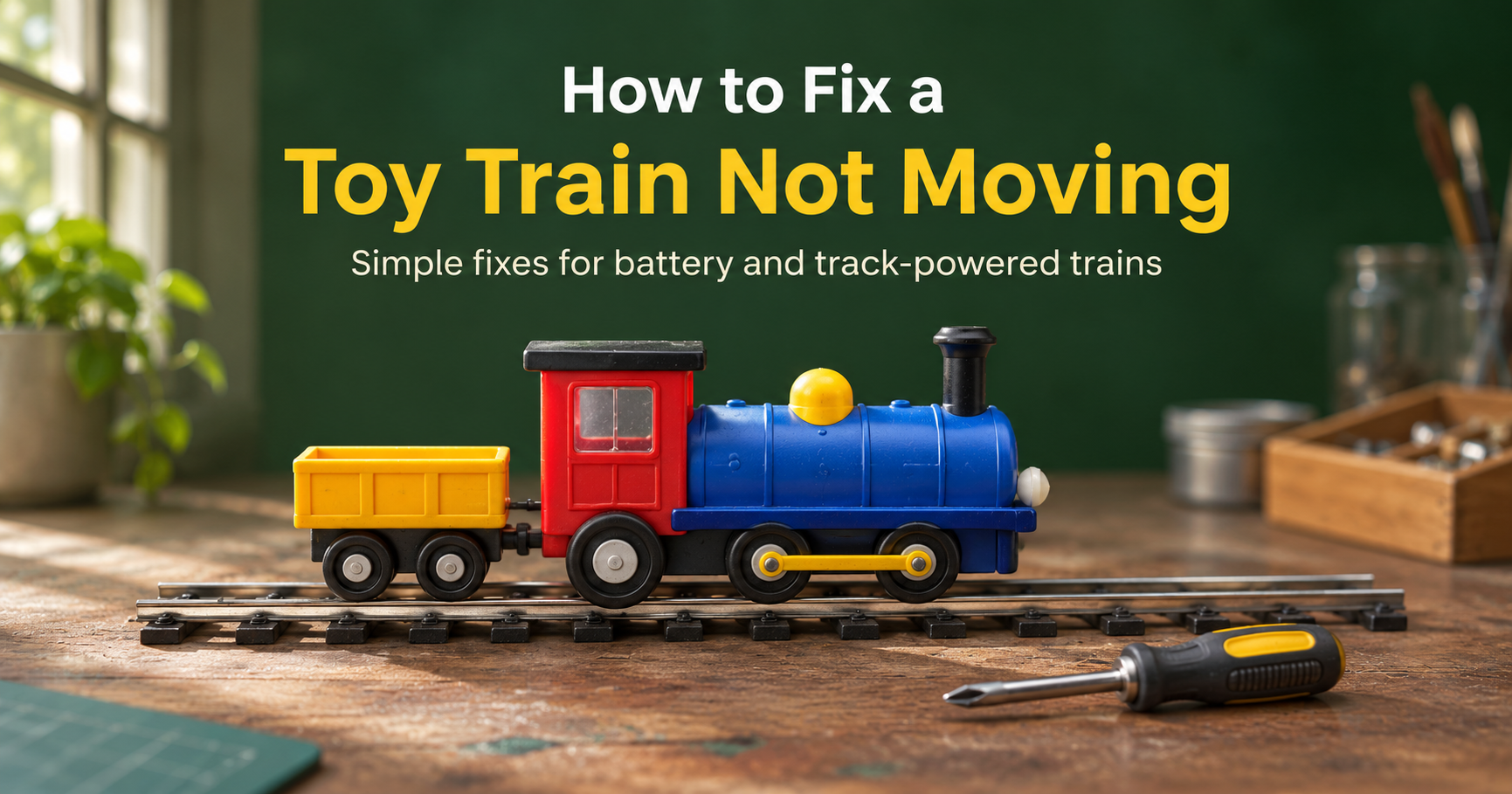
How to Fix a Toy Train Not Moving: Easy Troubleshooting Guide
There is nothing more disappointing than switching on a toy train and watching it sit perfectly still. Whether it is a battery-powered train for a toddler, a wooden railway engine, a remote control train set or a classic electric model on a powered track, the good news is the same: in most cases the fix is quick, cheap and does not need a repair shop.
In this guide you will learn how to fix a toy train that is not moving. We will go through the most common causes one by one, starting with the easiest checks, and show you exactly what to do for each. By the end you will know how to find the problem, fix it safely and stop it from happening again.
Why a Toy Train Stops Moving
A toy train needs three things to run: power, a clear path for that power to reach the motor, and wheels and gears that can turn freely. If any one of these is missing, the train will stop, run slowly or only twitch. The most common causes are:
- Dead, weak or incorrectly installed batteries in battery-powered trains and remote controls.
- Dirty or corroded battery contacts that block the flow of electricity.
- Dirty track or dirty wheels on electric track-powered trains.
- Loose or broken track connections and a faulty power pack or transformer.
- Hair, dust and debris jammed in the wheels and gears.
- A switch left off, a remote that is not paired or a train in the wrong mode.
- A worn motor or broken gear, which is less common but does happen with age.
Quick Diagnosis: Where Should You Start?
Before taking anything apart, decide which type of train you have. The troubleshooting path is different for battery-powered trains and for trains that get power from the track. The flowchart below shows the fastest route to the answer.
What You Need Before You Start
Most repairs need only a few household items:
- A fresh set of the correct batteries (the type printed in the battery box)
- A small Phillips screwdriver
- Cotton swabs and a soft cloth
- Isopropyl alcohol (rubbing alcohol) for cleaning metal contacts, rails and wheels
- Tweezers for removing hair, thread and debris
- A pencil eraser or fine sandpaper for light corrosion on contacts
- A very small amount of plastic-safe light oil for axles and gears
- Optional: a basic multimeter to test power on the track
Step 1: Check the Batteries First
Batteries cause more “dead” toy trains than any other problem, so always start here, even if the batteries are new. Brand-new batteries can be installed backward, and a weak battery can light up an LED while still lacking the power to turn a motor.
- Remove all batteries and check the direction of each one against the + and – marks inside the compartment.
- Replace every battery at once. Never mix old and new batteries, or different types. One weak cell can stop the whole train.
- Inspect the metal contacts. If you see white or green crust, the batteries have leaked. Wearing gloves, wipe the contacts with a cotton swab dipped in a little vinegar or isopropyl alcohol, then gently rub with a pencil eraser until the metal is shiny. Let it dry fully.
- Bend loose springs. If a spring contact has been flattened, gently pull it out a little so it presses firmly on the battery.
- Close the compartment properly. Many trains have a safety screw. If the cover is not fully closed, some models will not turn on.
Safety note: Keep batteries, especially small button cells, away from young children. Never try to recharge standard non-rechargeable batteries and always dispose of leaking batteries carefully.
Step 2: Check the Power Switch, Mode and Remote Control
It sounds obvious, but a surprising number of “broken” trains are simply switched off or in the wrong mode. Here is what to check:
- Power switch: Slide it fully to the ON position. Some trains have three positions such as forward, off and reverse, and sit between them.
- Sound-only or light-only modes: Some trains have a setting that plays sounds without driving the motor.
- Remote control trains: Replace the batteries in the remote and the train, then turn on the train first and the remote second. If the toy has a pairing or channel button, follow the manual to re-pair them.
- Interference: If two remote trains run near each other on the same channel, they can block each other. Switch channels or run them separately.
- Push-button or sensor trains: Some stop moving when the sensor on the front is blocked or when the train senses it has been picked up. Clean the sensor and place the train back on the track.
Step 3: Check the Power Pack and Track Connections
If your train gets its power through the rails, electricity must travel from the wall, through the power pack, into the track, up through the wheels and into the motor. A break anywhere in this chain will stop the train completely.
- Test the power pack. Make sure the wall outlet works by plugging in another device. Check that the power pack light comes on and that its cord is not frayed or bent. Always use the power pack that came with the train, because a different voltage can damage the motor.
- Check the wire clips or terminal track. The wires from the power pack must press firmly onto the metal rails or into the terminal piece. A loose clip is a very common problem.
- Press every track joint together. Gaps between rail pieces stop the current. Push the pieces firmly until the rails line up and touch. Bent rail connectors can be gently squeezed back into shape.
- Test other locomotives or a simple lamp car if you have one. If another train runs on the same track, the problem is the train. If nothing runs, the problem is the power, the track or the connections.
- Use a multimeter (optional). Set it to DC or AC voltage as your power pack requires and touch the probes to the two rails. You should see a voltage when the power is turned up. No voltage means the issue is before the train.
Step 4: Clean the Track and the Wheels
Over time dust, finger oils and tiny bits of dirt form a thin coating on the rails and wheels. You cannot always see it, but it blocks electricity just enough to make a train stutter, run slowly or stop.
- Unplug the power pack before cleaning.
- Dampen a soft cloth or cotton swab with isopropyl alcohol and wipe the top of each rail until the cloth stays clean.
- Wipe the wheels the same way. Hold the train and turn each wheel while you clean it so you reach all sides.
- Clean the small metal pickup strips or brushes that touch the wheels or rails, if your train has them.
- Let everything dry for a minute before you turn the power back on.
Do not use oil, polish or water on the rails. They leave a film that makes the electrical connection worse, and water can rust metal parts or damage the electronics.
Step 5: Look Inside at the Wheels, Gears and Motor
If the lights come on but the wheels do not turn, or you hear the motor humming without movement, the problem is usually mechanical. Hair, carpet fluff and thread wrap around axles very easily and can lock the wheels.
- Turn the train over and spin each wheel by hand. They should rotate smoothly. If one is stiff or stuck, look closely at the axle.
- Remove tangled hair and thread with tweezers or the tip of a small screwdriver. Cut it away carefully instead of pulling it, which can bend the axle.
- Open the underside if there are screws. Take a photo before you remove anything so that you can put the parts back in the right place.
- Check the gears. Look for broken or missing teeth, dirt packed between the teeth and gears that have slipped off their shaft. Push a loose gear back into place.
- Add a tiny drop of light, plastic-safe oil to each axle. One drop is enough. Too much oil collects dust and can run onto the wheels and rails.
- Listen to the motor. A smooth hum means the motor works. A buzz with no turning means jammed gears. Complete silence with fresh power usually points to a broken wire or a dead motor.
- Check the wires. Look for thin wires that have broken off at the battery box, the motor or the pickups. A small loose wire can often be pressed back or re-soldered.
Step 6: Check the Track Layout, Couplings and Load
Sometimes the train itself is perfectly fine and the layout is the problem.
- Derailments and sharp curves: If the train stops at the same place on every lap, look for a kinked track piece, a tight curve or a joint that does not line up.
- Too many cars: A small motor can only pull so much. Remove some cars and test the engine alone first.
- Stiff or jammed cars: One car with stuck wheels can stop the whole train. Detach each car and roll it by hand to find the culprit.
- Uneven surface: Wooden track on a bumpy floor, or electric track on thick carpet, can make joints separate. Use a flat surface when you can.
- Magnetic couplers: If magnets are dirty or have lost their strength, cars may separate and the engine may run off alone. Wipe them and, if needed, replace the couplers.
Troubleshooting Table: Symptoms and Fixes
Use this table to match what you see with the most likely cause and the quickest fix.
| Symptom | Likely Cause | What to Do |
|---|---|---|
| Nothing happens at all | Dead or backward batteries, switch off, no power | Replace batteries, check direction and switch, test the power pack |
| Lights work but wheels do not turn | Jammed gears or wheels | Remove hair and debris, check and re-seat the gears |
| Train jerks or stutters | Dirty track or wheels, weak batteries | Clean rails and wheels with isopropyl alcohol, use fresh batteries |
| Runs slowly | Low power, dry axles, too many cars | New batteries, one drop of oil on axles, pull fewer cars |
| Stops at the same spot on the track | Gap or dirt at a rail joint, kinked track | Reconnect and straighten the joint, clean the rails there |
| Motor hums but nothing moves | Slipped or broken gear | Open the underside, refit or replace the gear |
| Remote train does not respond | Remote batteries, pairing or channel problem | Replace both sets of batteries, re-pair, change channel |
| Works only when pushed or tilted | Loose wire or poor battery contact | Check wires and battery springs, secure or re-solder |
Tips for Different Types of Toy Trains
Battery-Powered Wooden Train Engines
These are the simplest toy trains. Most problems come from batteries, a stiff switch or hair around the wheels. Check the battery cover screw and clean the contacts first. If the engine has a motor with a small gear box, look for fluff around the gears.
Remote Control Train Sets
Replace batteries in both the remote and the train, then re-pair them as the manual explains. Keep the remote close and pointed at the train, and avoid running several sets on the same channel at once.
Track-Powered Electric Train Sets
These rely on clean rails and secure joints. Clean the track often and make sure the locomotive wheels and pickups are free of dirt. If a loco runs well on some track sections and not others, the problem is in the track, not in the train.
Model Railway Trains With Digital Control
If your model railway uses a digital control system, the train must be set to the right address and the controller must be sending a command. Check that the locomotive is on the correct address and that the speed setting is not zero. If a loco has been reset, it may revert to its default address.
Safety Tips While You Repair
- Always unplug the power pack before cleaning or opening anything.
- Use only the power pack made for your train and never connect it to a different brand or voltage.
- Do not use water, spray lubricants or strong solvents on motors, wiring or plastic parts.
- Keep small parts, screws and batteries away from young children.
- Do not open sealed rechargeable battery packs or try to charge non-rechargeable batteries.
- If a part smells burnt, feels very hot or looks swollen, stop using it and replace it.
How to Keep Your Toy Train Running Smoothly
A little regular care means fewer breakdowns. Follow the simple habits below to keep any toy train in top condition.
When to Repair and When to Replace
Most toy trains are worth repairing, and the fixes above solve the majority of problems. Consider repair or replacement when:
- The motor is completely silent after you have confirmed that power reaches it, which suggests a dead motor.
- Several gears have broken teeth or the gear housing is cracked.
- The circuit board is burnt or has been damaged by water or battery leakage.
- The cost of a replacement part is close to the price of a new train.
For a treasured or collectible train, contacting the manufacturer for a spare part or a repair guide is often the best next step. For a low-cost toy with a failed motor, replacing the whole engine is usually the more practical choice.
Frequently Asked Questions
Why is my toy train not moving even with new batteries?
The most common reasons are batteries installed backward, a switch that is not fully on, dirty or corroded battery contacts or a gear or wheel that is jammed. Check the battery direction first, clean the contacts and then spin the wheels by hand to test for blockages.
Why does my electric train stop on certain parts of the track?
This usually means a bad connection at a rail joint, a dirty section of rail or a track piece that is bent. Press the joints together firmly, clean that part of the track and straighten any kinked rails.
Can I use oil to make my toy train run better?
Yes, but only one tiny drop of a light, plastic-safe oil on axles and gear shafts. Never put oil on the track, the wheel surface or the electrical contacts, because it blocks the current and attracts dirt.
What should I use to clean the track?
Isopropyl alcohol on a soft cloth or cotton swab works well and dries quickly. Avoid water, metal polish and household sprays.
How do I know if the motor is broken?
If you have fresh power at the motor and the gears turn freely by hand but the motor does not move or make any sound, the motor has probably failed. If it hums but the wheels stay still, a gear is most likely jammed.
Why does my remote control train not respond?
Replace the batteries in both the remote and the train, make sure they are paired on the same channel and keep the remote within range. Other nearby remote toys can also cause interference.
Final Thoughts
A toy train that will not move is almost never a lost cause. Start with the easy checks: fresh batteries in the right direction, a working switch and a secure power connection. Then clean the track and the wheels, look for hair and debris in the gears and make sure the track layout is not stopping the engine.
With a little patience and the simple tools in this guide, you can bring most toy trains back to life in minutes. Keep everything clean, remove the batteries when the train is stored and your train will keep running for many more adventures.