






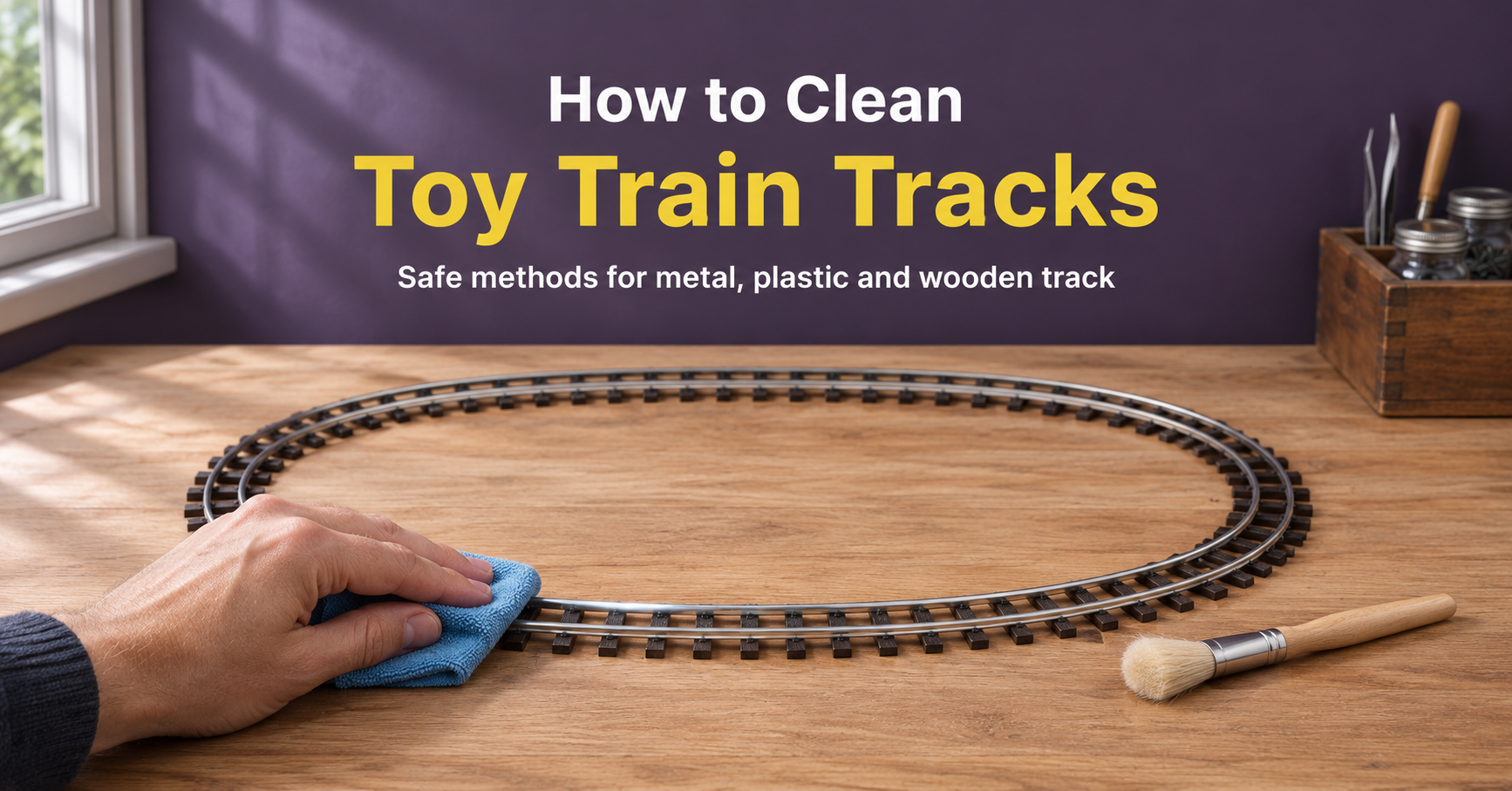
How to Clean Toy Train Tracks: A Complete Guide for Metal, Plastic and Wooden Track
Dirty track is the hidden reason behind many toy train problems. The locomotive stutters, slows down, flickers its lights or stops completely, and it is easy to blame the train. In reality, a thin film of dust, finger grease and oxidation on the rails is often all it takes to break the flow of electricity. On wooden and plastic track, dirt and sticky fingerprints can make joints stiff and cars harder to roll.
The good news is that cleaning toy train tracks is simple, cheap and takes only a few minutes. In this guide you will learn exactly how to clean metal, plastic and wooden toy train tracks, which products are safe, which to avoid and how often you should do it to keep your train running smoothly.
Why Clean Toy Train Tracks?
Regular track cleaning is one of the easiest ways to protect your toy trains and enjoy more reliable play. Here is why it matters:
- Better electrical contact: On electric train sets, the current travels through the rails and into the wheels. Dirt and oxidation weaken that connection.
- Smoother, quieter running: Clean rails reduce jerking, sparking, humming and sudden stops.
- Cleaner wheels and motors: Dirt on the track gets picked up by the wheels and carried into the gears and axles, where it causes wear.
- Longer track life: Removing grime and moisture slows down rust, pitting and discoloration.
- Healthier play: Toy tracks collect dust, pet hair and germs, especially wooden track that children touch and sometimes put in their mouths.
Signs Your Track Needs Cleaning
You do not have to wait for a breakdown. Clean your track when you notice any of these signs:
- The train slows down, jerks or stops on certain sections.
- Lights on the locomotive flicker or dim as it moves.
- You see small sparks or hear crackling from the rails or wheels.
- The rails look dull, brown, green or black instead of shiny.
- A grey or black film comes off on your finger when you touch the rail.
- Wooden or plastic pieces look dusty, sticky or stained, or the connectors feel stiff.
How Dirty Track Stops a Train
On an electric train, the wheels pick up power directly from the rails. Even a very thin layer of grime or oxidation is enough to act as an insulator and interrupt the current. The train may then run in short bursts, stall or only move when you give it a push. The picture below shows the difference between a dirty and a clean rail.
Know Your Track Type Before You Clean
The right cleaning method depends on what your track is made of. A method that works perfectly for metal rails can ruin a wooden track. Use the guide below to choose the safest approach.
Supplies You Need
You do not need special equipment. Here is what to gather before you start:
- Isopropyl alcohol (rubbing alcohol), 70% or higher, for metal rails
- Soft, lint-free cloths or microfiber cloths
- Cotton swabs for rail joints, connectors and tight corners
- A soft brush or an old, clean toothbrush
- A track cleaning rubber or a very fine abrasive block made for model railway track (for stubborn oxidation)
- Mild dish soap and a bowl of lukewarm water (for plastic and wooden track)
- A dry towel for drying parts straight away
- A vacuum cleaner with a brush attachment or a can of compressed air for loose dust
How to Clean Metal Toy Train Tracks (Electric Train Sets)
Metal rails need to be shiny and free of any film. This is the most important kind of cleaning for electric sets. Follow the six steps below, which are also shown in the picture.
Step 1: Switch Off and Unplug
Always disconnect the power pack from the wall socket before you touch the track. Remove the train and any cars from the rails so they are out of your way and do not get damaged.
Step 2: Remove Loose Dust and Debris
Use a vacuum with a brush attachment, a soft brush or compressed air to lift dust, pet hair, carpet fibers and crumbs from the track, ties and joints. Do this first. If you wipe a dusty rail, you only smear the dirt around.
Step 3: Wipe the Rails With Isopropyl Alcohol
Dampen a clean cloth or cotton swab with isopropyl alcohol. Do not soak it. Wipe along the top of each rail and the inner side where the wheel flange touches. Work in short sections and turn the cloth often to a clean part. When the cloth no longer picks up grey or black marks, the rail is clean.
Step 4: Treat Dull, Dark or Oxidized Spots
If alcohol alone does not remove dark patches, use a track cleaning rubber or a very fine abrasive block made for model railway rails. Rub lightly along the length of the rail, never across it. Light pressure is enough. After that, wipe the rail again with alcohol to remove all the dust that the abrasive creates.
Important: Do not use steel wool, because it leaves tiny metal fibers that can short out the track and get pulled into the motor. Avoid coarse sandpaper too, which scratches the surface and creates grooves where new dirt collects.
Step 5: Clean Rail Joints and Power Connections
The joints where two track pieces meet are the most common weak points. Wipe the metal rail connectors with a cotton swab and a little alcohol. Do the same for the power clips or terminal track. If a connector is loose, gently squeeze it with pliers so that it grips the rails tighter, then push the track pieces firmly together.
Step 6: Let It Dry, Then Test
Isopropyl alcohol dries in a minute or so. Once the rails are dry, reconnect the power and run your train slowly around the layout. Watch for any spot where it hesitates. If you find one, clean that section and its nearest joint once more.
Do not forget the train. Wipe the metal wheels with a cloth and a little alcohol too, since dirty wheels will quickly make a clean track dirty again.
How to Clean Plastic Toy Train Tracks
Plastic track is easy to clean and can be washed, as long as it has no electrical parts, batteries or metal rail inserts that could be harmed by water.
- Separate the track pieces so you can reach every side.
- Brush away dust and crumbs with a soft brush.
- Wash the pieces in a bowl of lukewarm water with a few drops of mild dish soap, using a soft cloth or sponge. Use an old toothbrush for grooves and connector slots.
- Rinse with clean water and dry each piece thoroughly with a towel.
- Leave them in the air for 15 to 30 minutes until fully dry before you put them back together.
Avoid hot water, which can warp thin plastic, and strong solvents, bleach or nail polish remover, which can make plastic cloudy, brittle or sticky. If a piece has metal rail strips, clean those with alcohol using the metal method above rather than soaking the whole piece.
How to Clean Wooden Toy Train Tracks
Wood absorbs water, so it needs a gentler approach. Never soak wooden track, put it in a dishwasher or leave it sitting in water. Wood can swell, crack, warp or lose its paint and finish.
- Brush off dust and wipe the pieces with a dry cloth.
- Dampen a soft cloth with lukewarm water and wring it out until it is only slightly damp. For sticky marks, add a tiny drop of mild dish soap.
- Wipe each piece, paying attention to the grooves and the connector ends where grime collects.
- Go over the pieces with a second cloth dampened with plain water to remove any soap.
- Dry each piece straight away with a clean towel and leave them standing in a well-ventilated place until fully dry.
For children’s toys that often go in mouths, stay with plain water or very mild soap and skip strong disinfectants. If the wood feels rough or splintery after cleaning, stop using that piece and replace it.
What to Use and What to Avoid
Using the wrong product is the most common reason track cleaning goes wrong. Here is a simple summary:
Why You Should Never Oil the Rails
Some people think a little oil will help the train glide. In fact oil on the rails creates a sticky layer that traps dust and blocks electrical contact. It can also make the wheels slip and pull dirt into the gears. Oil belongs on the axles and gears of the train in very small amounts, never on the track.
Quick Reference Table: Which Method for Which Problem?
| Problem | Track Type | Best Solution |
|---|---|---|
| Light dust and fluff | All types | Vacuum brush head, soft brush or compressed air |
| Grey or black film on rails | Metal | Isopropyl alcohol on a lint-free cloth |
| Dark, dull or oxidized spots | Metal | Track cleaning rubber, then wipe with alcohol |
| Sparking or flickering at joints | Metal | Clean connectors with a swab and tighten them |
| Sticky fingerprints and spills | Plastic | Mild soapy water, rinse, dry |
| Dirty or grimy grooves | Wood | Slightly damp cloth, soft brush and quick drying |
| Light surface rust | Metal | Fine abrasive block, wipe with alcohol, dry fully |
What About Rust and Corrosion?
Light rust on steel rails, which looks like orange or brown dusty patches, can usually be removed with a fine abrasive block and then wiped with alcohol. Dry the rails completely and keep them in a dry place afterward. If the rust has caused deep pitting, flaking or holes, the rail will keep collecting dirt and giving a poor connection. In that case it is better to replace that track piece than to keep fighting it.
Moisture is the main cause of rust. Never store metal track in a damp basement, garage or loft, and never leave the rails wet after cleaning.
How Often Should You Clean Toy Train Tracks?
The right schedule depends on how often you run your train and where you keep the track. The more you play, the more often you should clean. Use the chart below as a simple guide.
Dusty rooms, homes with pets, tracks laid on carpet and tracks used in basements or garages collect dirt faster, so clean those more often than the schedule suggests.
Tips to Keep Your Track Cleaner for Longer
- Wash your hands before play. Finger oils and sticky residue on rails are a surprisingly big cause of dirt.
- Keep the layout off dusty floors. Use a hard, flat, clean surface or a play mat where possible.
- Cover the layout between sessions with a light sheet, or take it apart and store it in a lidded box.
- Keep food and drinks away from the play area to avoid spills and crumbs.
- Clean the train wheels as often as the track. A clean wheel keeps a clean rail clean.
- Store track dry. Make sure each piece is dry before packing it, and use a cool, dry cupboard instead of a damp room.
- Run the train regularly. Rails that are never used oxidize faster than those that get regular use.
Safety Tips
- Never clean powered track while the power pack is plugged in.
- Do not use water or wet cloths on any track that carries electricity or has batteries or electronics attached.
- Use alcohol in a well-ventilated room and keep it away from flames, sparks and young children.
- Keep cleaning products and small parts out of the reach of children.
- Let all parts dry fully before reconnecting the power.
Frequently Asked Questions
What is the best thing to clean toy train tracks with?
For metal rails, isopropyl alcohol on a lint-free cloth is the safest and most effective everyday cleaner. For plastic track, use mild soapy water. For wooden track, use a slightly damp cloth and dry it straight away.
Can I use water to clean electric toy train tracks?
It is best not to. Water can cause rust and may damage connectors and electrical parts. Use isopropyl alcohol on rails and only a barely damp cloth on non-electrical parts, then dry everything completely.
Is rubbing alcohol safe for toy train rails?
Yes, it is widely used for cleaning metal rails because it removes grease and grime and evaporates quickly without leaving a residue. Use it in a ventilated area and let it dry before running the train.
Why does my train still stutter after I cleaned the track?
Check the rail joints, the power connection and the train’s wheels. A loose joint, a dirty wheel or a weak power pack is often the real culprit. If the train still stutters, clean the wheels and any metal pickups on the locomotive.
Can I use a pencil eraser to clean the rails?
A clean, soft eraser can lift light oxidation, but it can leave crumbs and a slight residue. A track cleaning rubber made for this purpose is a better choice, and you should always wipe the rail with alcohol afterward.
How do I disinfect wooden train tracks?
Wipe them with a slightly damp cloth and a tiny amount of mild soap, then rinse with a cloth dampened with plain water and dry straight away. Avoid soaking and strong chemicals, which can damage the wood and the paint.
Final Thoughts
Knowing how to clean toy train tracks is a small skill that makes a big difference. Remove dust first, match the method to the track material, use isopropyl alcohol on metal rails, keep water away from electric sets and never oil the rails. Finish by cleaning the train’s wheels, drying everything fully and testing the layout.
A few minutes of regular cleaning keeps your train running smoothly, protects your track from rust and wear and makes every play session more enjoyable.