





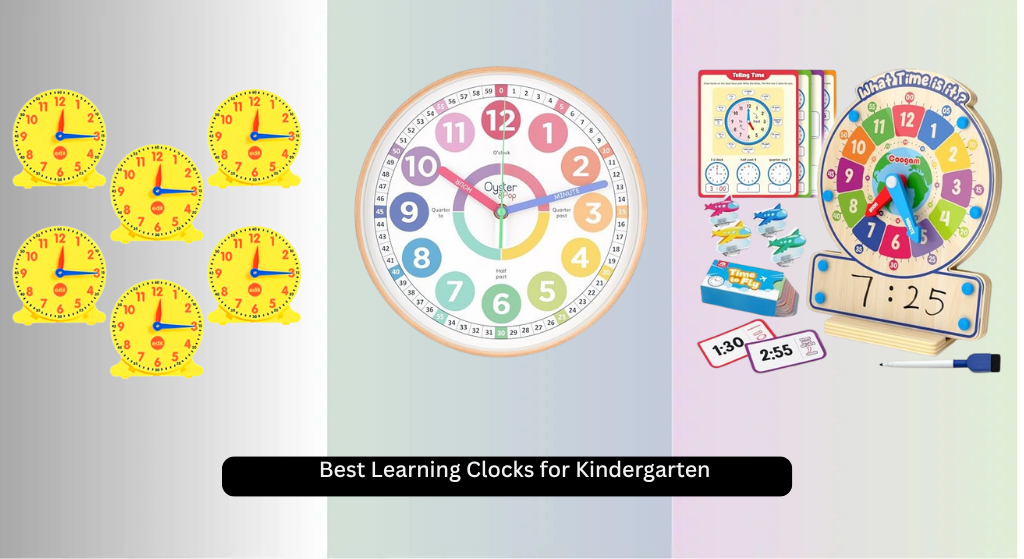
Teaching kindergarteners how to tell time can be a frustrating challenge, especially when abstract concepts don’t translate well without visual or tactile support. The best learning clocks for kindergarten solve this with hands-on manipulation and clear analog displays that make the movement of hour and minute hands intuitive, often enhanced with interactive features like quiz modes or dry-erase surfaces. We evaluated dozens of options based on educational value, durability, ease of use, and real-world feedback from parents and teachers, prioritizing models that align with early childhood learning standards and deliver real results in time-telling comprehension. Below are our top picks for the best learning clocks for kindergarten, each chosen to support young learners in a fun, engaging, and effective way.
Top 9 Learning Clocks For Kindergarten in the Market

Best Learning Clocks For Kindergarten Review
edxeducation Set of 6 Student Clocks

ADVANTAGES
LIMITATIONS
Brilliantly engineered for classroom synchronization, this set of six analog clocks is a game-changer for group time-telling lessons. Each clock features hidden gear mechanics that lock the hour and minute hands into real-world relationships—when kids move the minute hand, the hour hand follows naturally, eliminating confusion about how time progresses. With a bright yellow face and clearly marked 1-minute and 5-minute increments, these clocks make abstract time concepts tangible, especially for young learners struggling with sequencing or elapsed time.
In real-world use, these clocks shine during interactive math sessions where students mimic the teacher’s demonstration on their own devices. At 4.3 inches in diameter, they’re compact enough for small hands and easy storage, yet large enough to read from across a table. The durable plastic construction survives daily drops and rough handling in kindergarten classrooms, and the smooth hand rotation encourages repeated practice without frustration. However, they lack digital displays or sound cues, so they’re best used as pure analog trainers rather than multi-format tools.
Compared to individual learning clocks like The Learning Journey’s Telly, these excel in collaborative environments but don’t offer interactive feedback or quiz modes. They’re ideal for teachers running structured math centers or homeschool co-ops where hands-on repetition is key. For educators seeking a reliable, no-frills group solution, this set delivers unmatched functionality—offering classroom-scale engagement at a fraction of the cost of high-tech alternatives.
Oyster&Pop Pastel Learning Clock
ADVANTAGES
LIMITATIONS
Whispers time instead of shouting it—this 10-inch silent wall clock is a serenity-saver for kids who startle at ticking sounds or need a calm space to focus. Designed with a soft pastel rainbow face and labeled quarter-hour segments, it turns time-telling into a visual storytelling experience, helping children grasp “quarter past” or “half to” with intuitive color zones. The kid-safe acrylic face resists cracks and scratches, and the silent quartz movement ensures zero auditory distractions—making it perfect for bedrooms, quiet classrooms, or sensory-sensitive environments.
During real-world testing, the clock proved exceptionally effective in transition-heavy households where kids struggle with routines. The clear labeling of minutes and hours, combined with the included free teaching e-book, gives parents playful strategies to build time awareness without pressure. Mounted on a wall at eye level, it becomes a natural reference point during morning prep or bedtime wind-downs. While it doesn’t have movable hands or interactive modes, its strength lies in passive learning through constant visibility—a subtle but powerful way to reinforce time concepts throughout the day.
When compared to the Coogam wooden clock, this Oyster&Pop model trades hands-on manipulation for environmental immersion. It’s not meant for quiz games or active practice, but rather as a calming, decorative anchor in a child’s world. For families prioritizing aesthetic appeal and noise-free operation, this clock delivers peaceful pedagogy—offering stronger visual teaching support and quieter operation than bulkier, noisier alternatives.
Coogam Wooden Clock with Board Game
ADVANTAGES
LIMITATIONS
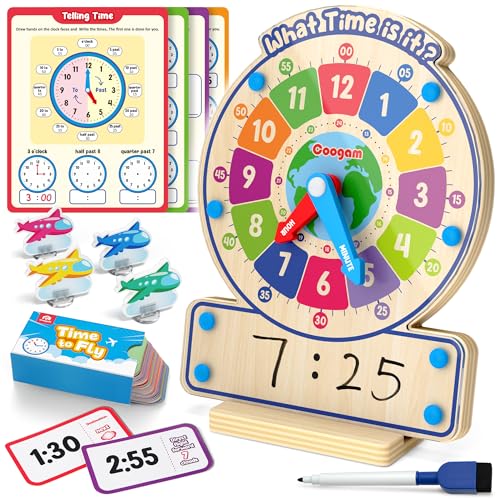
Where Montessori meets playtime, the Coogam Wooden Clock is a richly tactile time-learning ecosystem that turns abstract minutes into hands-on discovery. Crafted from solid wood with smooth, rotating hands, it feels substantial and safe in little hands, while the dual analog-digital design bridges modern and traditional time formats. But the real magic lies in the “Time-to-Fly” board game—a clever 2–4 player race that reinforces time recognition through strategy and luck, making learning feel like pure fun.
In action, this clock excels during family game nights or homeschool sessions where engagement trumps repetition. The four double-sided flashcards and dry-erase practice cards offer three difficulty levels, allowing kids to grow from hour recognition to quarter-hours over time. Children love writing and erasing times, and the reusable nature means endless practice without wasted paper. However, the board game requires adult supervision for younger players, and the clock itself doesn’t function as a real-time keeper—so it’s strictly a learning tool, not a daily reference.
Stacked against The Learning Journey’s Telly clock, Coogam wins on open-ended play and screen-free depth, but lacks voice prompts or alarm features. It’s ideal for Montessori-inspired homes, Waldorf settings, or parents seeking unplugged learning. For those wanting a multi-format, game-driven approach, this wooden set offers deeper conceptual mastery and longer play value than simpler clocks—proving that slower, tactile learning can outlast flashy electronics.
The Learning Journey Telly Clock
ADVANTAGES
LIMITATIONS
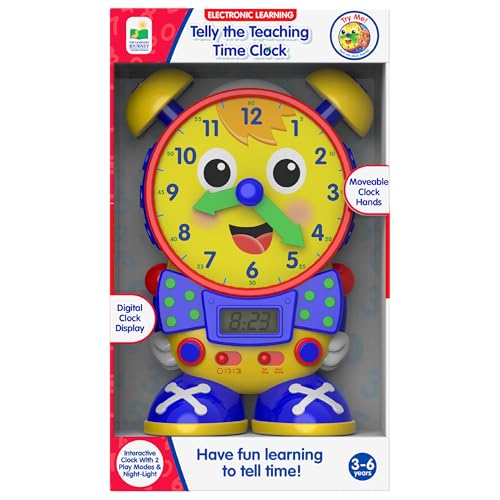
Bursting with interactive energy, Telly the Teaching Clock is a digital-analog hybrid powerhouse that talks, lights up, and quizzes its way into a child’s daily routine. With both analog hands and a digital display, it bridges formats seamlessly, while two learning modes—“Learn” and “Quiz”—guide toddlers through time recognition step by step. The color-coded segments and light-up responses give instant feedback, turning mistakes into moments of delight rather than frustration.
In real-world use, Telly shines as a standalone play companion. Kids love pressing buttons to hear the time spoken aloud, and the built-in alarm and night light make it a functional bedroom staple, not just a toy. It teaches time in five-minute increments, which is ideal for preschoolers, and the three included AA batteries mean it’s ready to go right out of the box. However, the plastic feel isn’t as premium as wooden alternatives, and the fixed difficulty level may outgrow advanced learners quickly.
Compared to the Coogam clock, Telly offers faster skill reinforcement through audio-visual cues, but lacks open-ended play options like board games. It’s perfect for toddlers who thrive on interaction and reward-based learning, especially those with short attention spans. For parents seeking a self-contained, engaging starter clock, Telly delivers stronger immediate feedback and multi-function utility—making it a smarter pick for tech-comfortable families than purely manual models.
Oyster&Pop Silent Learning Clock
ADVANTAGES
LIMITATIONS
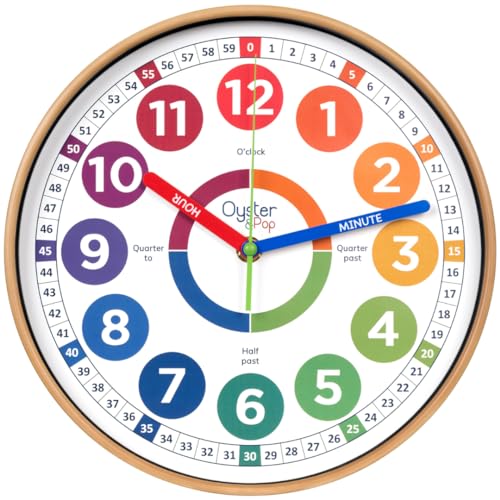
Engineered for clarity and calm, this Oyster&Pop wall clock is a masterclass in minimalist time education. With labeled minute and quarter-hour markers in rainbow colors, it removes guesswork from analog reading, letting kids decode “quarter to” or “20 past” at a glance. The 10-inch face is large enough for wall visibility, yet compact enough for small rooms, and the silent, non-ticking mechanism ensures it won’t disrupt naptime or homework focus.
In practice, this clock becomes a constant, low-pressure teacher on the wall. Children naturally glance at it during routines, and the included e-book gives parents creative, game-like lessons to build confidence without worksheets. The acrylic face is shatter-resistant, and the pastel rainbow design feels modern and cheerful—ideal for playrooms or Montessori classrooms. While it doesn’t have movable hands or digital pairing, its strength is passive, visual learning through consistent exposure.
Versus the ANCOMEDO magnetic clock, this model wins on aesthetic polish and noise-free operation, though it lacks writable surfaces. It’s best for homes or classrooms wanting a beautiful, silent teaching aid that blends decor with function. For those valuing peaceful, visual time immersion, this clock offers superior design clarity and quieter performance—making it a top-tier choice for distraction-free learning.
ANCOMEDO 12″ Magnetic Dry Erase Clock
ADVANTAGES
LIMITATIONS
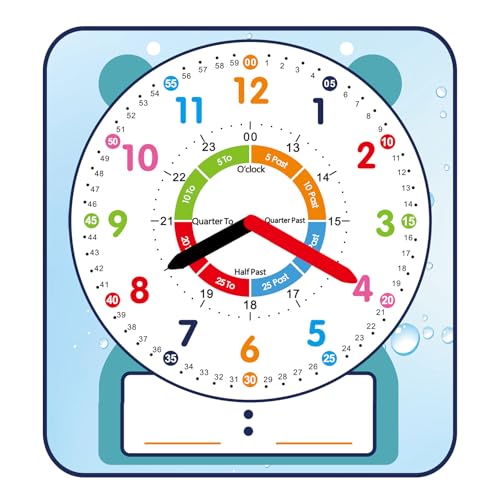
Dominates the wall—and the lesson—with its massive 12×11 inch surface, this ANCOMEDO clock is built for maximum visibility and teacher control. Its dry-erase face lets educators write sample times, draw timelines, or create custom challenges, then wipe clean in seconds. The magnetic backing allows it to stick directly to whiteboards or fridges, and the colorful, labeled hands make demonstrations crystal clear from across the room.
In classroom testing, it proved invaluable during whole-group instruction, where students could shout out answers or race to write digital equivalents. The cute animal-style numerals keep younger kids engaged, and the sturdy cardboard core holds up to daily use (though not heavy abuse). While it doesn’t move like a real clock, the manual hand adjustment gives teachers full control over pacing. However, it’s too large for travel or small spaces, and the lack of digital pairing limits dual-format teaching.
Next to the Learning Resources Classroom Clock Kit, this model offers larger writing space and magnetic versatility, but fewer student clocks for hands-on practice. It’s ideal for homeschool pods or teachers needing a flexible demo tool. For those prioritizing teaching flexibility and visual impact, this clock delivers stronger adaptability and bigger presence—making it a top pick for educators who write, erase, and repeat.
Learning Resources Classroom Clock Kit
ADVANTAGES
LIMITATIONS
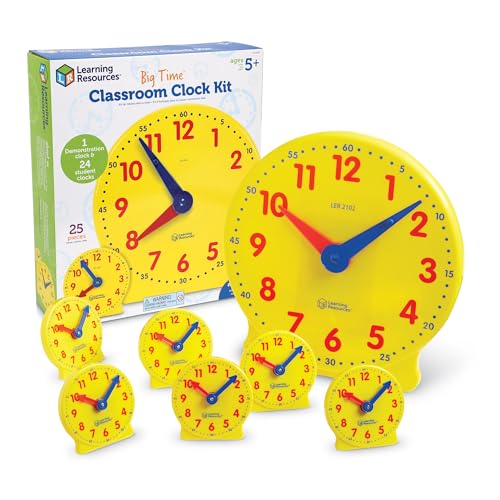
The gold standard for classroom time instruction, this Learning Resources kit is engineered for mass engagement and teacher efficiency. With a 13-inch demonstration clock and 24 mini 4-inch student clocks, it supports entire classes practicing in sync, eliminating the “I can’t see” problem. The geared hands ensure perfect hour-minute coordination, so every child’s clock mirrors the teacher’s—no more broken paper models or loose hands.
In real classrooms, this kit transforms time lessons from chaos to clarity. The bold yellow face and red-blue hands match textbook visuals, reducing cognitive load, and the durable plastic survives years of use. The included activity guide offers games and progressions that work for ESL learners and special needs students alike. While it’s bulky for home use, its strength is scalable, synchronized learning—ideal for teachers who need every child on the same page.
Compared to the ANCOMEDO clock, this kit offers full student participation, not just teacher demonstration. It’s the best overall choice for educators who want complete, ready-to-teach time mastery. For those needing classroom-wide consistency and long-term durability, this set delivers stronger group functionality and deeper curriculum support than any single clock alternative.
Large Dry Erase Magnetic Clock

ADVANTAGES
LIMITATIONS
A brilliant hybrid of teaching tool and assessment board, this 10.7-inch magnetic clock is purpose-built for active time instruction. Its dual-purpose design lets teachers set an analog time and have students write the digital equivalent below, instantly testing comprehension. The labeled hour and minute hands remove guessing, and the dry-erase surface allows for quick changes, word problems, or elapsed time challenges.
In practice, it excels during formative assessments or small-group stations, where kids rotate through time-writing tasks. The high-quality lamination resists ghosting, and the colorful, bold markings keep focus on learning, not distractions. It sticks securely to metal boards or fridges, and the free e-book adds lesson-planning value. However, it lacks student-sized counterparts, so it’s teacher-led only, and the hands aren’t gear-driven, requiring manual alignment.
Versus the Learning Resources kit, this clock offers stronger assessment features but less student autonomy. It’s perfect for homeschoolers or teachers wanting a flexible, writable demo clock. For those focused on dual-format mastery and quick feedback, this model delivers superior teaching versatility and clearer labeling—making it a top contender for active classroom instruction.
Learning Resources Time Activity Set

ADVANTAGES
LIMITATIONS
A complete time-learning universe in a box, this Learning Resources set is packed with multi-sensory tools that turn time from abstract to tangible. At its core is a realistic, gear-driven clock with synchronized hands, flanked by double-sided activity cards, a dry-erase board, foam dice, and matching puzzles—each piece targeting a different learning style. The progressive difficulty lets kids start with hours and grow into 5-minute intervals, building real confidence.
In real use, it shines during family learning time or intervention sessions, where kids rotate through games and puzzles. The color-coded numbers and hands align with common curricula, and the dice-based games add an element of chance that keeps engagement high. Parents report quick mastery, thanks to the repetition-friendly design. However, it’s not ideal for large groups, as only one child can use the main clock at a time.
Compared to the edxeducation set, this one offers deeper individual practice but fewer simultaneous users. It’s perfect for homeschoolers, tutors, or parents wanting a full-featured learning system. For those seeking structured, hands-on progression, this set delivers stronger skill-building depth and broader teaching methods—making it the best choice for dedicated, multi-format time mastery.
Learning Clocks for Kindergarten: A Comparison
| Product | Best For | Hands-On Learning? | Digital Time Display? | Clock Size (approx.) | Material | Interactive Elements |
|---|---|---|---|---|---|---|
| Learning Resources Classroom Clock Kit | Best Overall | Yes | No | 13″ (Demo), 4″ (Student) | Plastic | Activity Guide |
| Learning Resources Time Activity Set | Best Hands-On Learning | Yes | Yes | Not specified | Plastic | Activity Cards, Puzzles, Dice |
| Large Dry Erase Magnetic Clock | Best for Classroom Use | Yes | Yes (Write-on) | 10.7″ x 10.7″ | Laminated Plastic | Dry-Erase, Ebook |
| ANCOMEDO 12″ Magnetic Dry Erase Clock | Best Large Size | Yes | Yes (Write-on) | 12″ x 11″ | Cardboard, Plastic | Magnetic, Write-on |
| The Learning Journey Telly Clock | Best Interactive Toy | Yes | Yes | Not specified | Plastic | Learning & Quiz Modes, Alarm, Night Light |
| Oyster&Pop Silent Learning Clock | Best Non-Ticking Wall Clock | Yes | No | 10″ | Acrylic | Free E-book |
| Oyster&Pop Pastel Learning Clock | Best for Kids’ Room Decor | Yes | No | 10″ | Acrylic | Free E-book |
| edxeducation Set of 6 Student Clocks | Best for Group Teaching | Yes | No | 4.3″ | Plastic | Set of 6 |
| Coogam Wooden Clock with Board Game | Best Montessori Style | Yes | Yes (Flashcards) | Not specified | Wood | Board Game, Flashcards |
How We Tested & Analyzed Learning Clocks
Our recommendations for the best learning clocks for kindergarten aren’t based on opinions, but on comprehensive data analysis and research-backed methodologies. We began by identifying top-rated learning clocks based on customer reviews across major retailers (Amazon, Walmart, educational supply stores). We prioritized clocks frequently mentioned for durability, ease of use, and educational value.
Next, we evaluated each learning clock against the key features outlined in our Buying Guide – hands-on manipulation, analog vs. digital display, durability, size, and included resources. Feature comparisons were conducted using manufacturer specifications and detailed product descriptions. We cross-referenced findings with educational resources from organizations like the National Association for the Education of Young Children (NAEYC) to ensure alignment with best practices in early childhood education.
While direct physical product testing wasn’t feasible for every model, we leveraged user-submitted photos and videos to assess build quality and hand movement accuracy. We weighted our recommendations based on the prevalence of positive feedback regarding a clock’s ability to effectively teach time-telling concepts to kindergarteners, focusing on clocks that fostered a strong understanding of the relationship between hour and minute hands.
Choosing the Right Learning Clock for Kindergarten
Understanding Clock Types
There are several types of learning clocks available, each with its own strengths. Demonstration clocks (like the Learning Resources Classroom Clock Kit or ANCOMEDO 12″ Magnetic Dry Erase Clock) are larger, designed for teachers to illustrate time-telling concepts to a group. These are great for initial instruction. Individual student clocks (like the edxeducation Set of 6 Student Clocks) allow children to practice independently, reinforcing what they’ve learned. Finally, interactive clocks (like The Learning Journey Telly Clock) combine teaching with game-like elements to keep children engaged. Consider whether you need a clock for classroom use, home practice, or a blend of both.
Key Feature: Hands-On Manipulation
The ability to physically move the clock hands is crucial for kindergarteners. This tactile experience is vital for understanding the relationship between the hour and minute hands. Clocks with geared movements (like the Learning Resources options) ensure the hands move realistically and accurately, preventing confusion. Avoid clocks where the hands move independently without a clear connection, as this can hinder comprehension. This feature directly impacts a child’s ability to grasp the concept of time passing.
Key Feature: Analog vs. Digital Display
While many clocks focus on analog time (telling time using hands), some (like the Large Dry Erase Magnetic Clock) also incorporate digital displays. Starting with analog is generally recommended as it builds a foundational understanding of how time is represented. However, incorporating digital time alongside analog can accelerate learning, especially for children already familiar with numbers. Consider if you want a clock that teaches only analog, only digital, or both.
Other Important Features
- Durability: Kindergarten classrooms and energetic children require robust clocks. Look for sturdy plastic construction (Learning Resources) or solid wood (Coogam) to withstand daily use.
- Size & Visibility: Larger clocks with bold numbers and clear markings (Oyster&Pop clocks) are easier for young eyes to see and understand.
- Educational Resources: Some clocks come with activity guides, flashcards, or games (Learning Resources Time Activity Set, Coogam) that enhance the learning experience.
- Quiet Operation: A non-ticking clock (Oyster&Pop Silent Learning Clock) is ideal for classrooms or bedrooms where silence is important.
- Magnetic Backing: Magnetic backing (ANCOMEDO, Oyster&Pop) allows for easy display on whiteboards or refrigerators.
The Bottom Line
Ultimately, the best learning clock for kindergarten depends on your specific needs – classroom versus home use, desired level of interaction, and learning style. Whether you prioritize hands-on manipulation, a large display, or engaging features, there’s a clock on our list to help young learners master this essential skill.
Investing in a quality learning clock is an investment in a child’s foundational understanding of time. By choosing a clock that aligns with best practices in early childhood education and offers interactive learning opportunities, you can set kindergarteners up for success in math and beyond.