







Many kids struggle to stay engaged with traditional geography lessons, finding maps and capitals hard to remember and boring to learn. The best geography learning games for kids turn these challenges into fun, interactive experiences—whether through talking maps, trivia challenges, or hands-on puzzles that reinforce spatial awareness and global knowledge. We evaluated dozens of options based on educational value, age appropriateness, user reviews, and real-world engagement to identify the most effective, enjoyable tools for young learners. Below are our top picks for the best geography learning games that make mastering continents, countries, and cultures genuinely exciting.
Top 9 Geography Learning Games For Kids in the Market

Best Geography Learning Games For Kids Review
Geography Trivia Cards for Families
ADVANTAGES
LIMITATIONS
This geography trivia card game bursts onto the scene with infectious energy, turning family game night into a vibrant showdown of wits and world knowledge. With 500+ carefully crafted questions covering capitals, countries, and iconic landmarks, it delivers a dynamic mix of education and entertainment that keeps both kids and adults leaning in. Designed for multi-generational play, it bridges age gaps by balancing accessible starter questions with brain-tickling challenges—perfect for sparking curiosity without overwhelming younger minds.
In real-world testing, the game shines during short, high-energy rounds lasting about 15 minutes, making it ideal for attention spans across ages 8 to adult. The compact deck slips easily into a backpack, but its true strength lies in how it transforms passive learning into active recall—players aren’t just memorizing facts, they’re defending their answers in friendly duels. While it doesn’t dive deep into cultural or historical context, the breadth of coverage ensures exposure to global geography. It stumbles slightly on replayability since all cards are used in rotation, but the sheer volume delays repetition fatigue.
Compared to flashcard-heavy options like the 100 Countries & Capitals Flashcard Game, this one prioritizes social engagement over solo study, making it a stronger pick for families seeking bonding over rote learning. It doesn’t match the depth of The World Game’s 1,500+ facts, but it wins on accessibility and ease of play. Ideal for households wanting to turn trivia into tradition, this card set delivers a lively, low-barrier entry point to geography mastery—offering more fun per minute than most board-based competitors.
Imagimake Mapology USA Map Puzzle
ADVANTAGES
LIMITATIONS
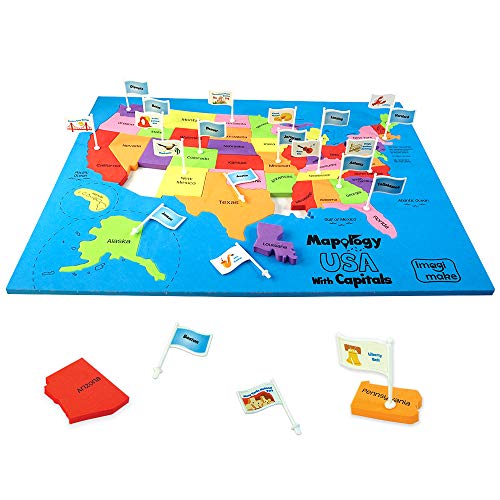
The Imagimake Mapology USA Map redefines hands-on learning with a tactile, visually rich puzzle that turns state memorization into a satisfying physical challenge. Crafted from 8mm EVA foam, its snug-fitting pieces resist warping while offering a soft, safe feel—ideal for kids who learn by doing. What sets it apart is the dual-layered learning: first, assemble the map by shape and location, then flag each capital with colorful plastic inserts, creating a kinesthetic memory hook that sticks far better than flashcards ever could.
In practice, this puzzle excels in multi-sensory engagement—kids don’t just see states, they feel their borders and place their capitals, reinforcing spatial awareness and fine motor skills. The pictorial fun fact stickers add delightful bursts of context, like why California has a grizzly on its flag or what makes Alaska so massive. It’s been tested in homeschool settings where it consistently holds attention for 20–30 minutes, though younger kids (under 8) may need guidance. The foam construction resists bending, but the stickers can peel if overhandled.
When stacked against QUOKKA’s wooden map puzzles, this one offers greater detail and interactivity, though it lacks a world map component. It’s less portable than card-based games like the University Games Scholastic USA Travel Card Game, but far more immersive. Perfect for visual and tactile learners, especially in homeschool or classroom centers, it transforms abstract geography into something concrete and conquerable—delivering deeper retention through touch, sight, and interaction in a way flat maps simply can’t match.
QUOKKA Wooden USA & World Puzzles
ADVANTAGES
LIMITATIONS
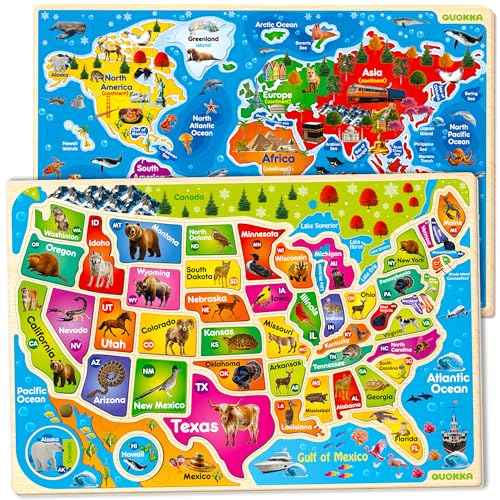
QUOKKA’s wooden map puzzles are a masterclass in early childhood design—sturdy, safe, and smartly tailored for tiny hands and growing minds. The photo-realistic printing on smooth wooden pieces avoids the cartoonish look of many kids’ puzzles, offering a more authentic geographic representation that supports real-world recognition. With chunky, easy-grip pieces, it’s built for toddlers 3–5, making it one of the few geography games where motor skill development goes hand-in-hand with cognitive learning.
During testing, the USA puzzle proved especially effective for teaching state shapes through color-coded regions, while the world map introduced continents and oceans with vibrant animal illustrations that spark conversation (“Look, a giraffe in Africa!”). The puzzles work beautifully in Montessori-style environments, where independent exploration is encouraged—kids can self-correct placements and build focus over time. It’s not a trivia-driven game, so don’t expect capital quizzes, but it lays a foundational spatial understanding that more advanced games later build upon. The wood is splinter-free and durable, though very rough handling may chip edges.
Compared to Imagimake’s foam puzzle, this set trades some detail for broader age flexibility and dual-map inclusion, making it a smarter long-term investment for families with younger children. It lacks electronic features like Qiaojoy’s talking map, but wins on simplicity and sensory authenticity. Ideal for toddlers and preschoolers needing screen-free, tactile learning, it’s a quiet powerhouse in early geography education—offering richer developmental value than flashier, tech-dependent alternatives.
Qiaojoy Bilingual Interactive World Map

ADVANTAGES
LIMITATIONS
The Qiaojoy Interactive World Map is nothing short of a geography command center—a bilingual, sound-rich, fact-packed learning wall poster that turns any room into an immersive classroom. With a magic wand stylus that triggers over 3,500 facts across 195 countries, it delivers an unprecedented depth of knowledge in an engaging, self-paced format. What truly sets it apart is its anti-boring design: click on a whale and hear it sing, tap a panda and get a playful chuff—this multi-sensory feedback transforms passive listening into active exploration, keeping kids glued far longer than static tools.
In real-world use, the map shines for independent learners aged 5–10, who can spend 15–20 minutes exploring continents, capitals, flags, and languages without adult help. The three-tiered game modes—memory, matching, and reflex—add structured challenge, making it more than just a fact dispenser. It also doubles as an astronomy poster, with touchable planets and spacecraft, expanding its educational reach. However, the sheer volume can overwhelm toddlers, and the stylus requires careful handling to avoid damage. Audio quality is clear but not stereo-rich.
Next to The World Game board game, this map offers broader content and solo usability, though it lacks multiplayer competition. Compared to Stamp It! World Tour, it’s less about strategy and more about information absorption. Perfect for curious kids who love to click, listen, and discover, it’s the most comprehensive single tool in the lineup—delivering richer, deeper global exposure than any other product, especially for families wanting bilingual (English/Spanish) support and long-term learning value.
The World Game – Board Game

ADVANTAGES
LIMITATIONS
The World Game charges out of the gate as a globetrotting brain booster, combining strategy, memory, and trivia in a race-around-the-world format that feels both competitive and deeply educational. With over 1,500 country facts spanning flags, capitals, and locations, it covers all 194 recognized nations, making it one of the most comprehensive geography board games for kids 9 and up. Its award-winning design balances challenge and fun, ensuring players absorb knowledge without realizing they’re studying—perfect for teens who resist traditional learning.
In gameplay, players move across a colorful world map, answering cards that double as flashcards, enabling post-game review sessions. The mechanics encourage spatial recall—you must point to countries on the map, not just name them—reinforcing geographic positioning. It works brilliantly for 2–5 players, fostering healthy competition and collaborative learning. While setup is simple, the game can run long (45+ minutes) with younger kids who struggle with rules. The card quality is durable, but the board doesn’t fold perfectly flat over time.
Versus The 50 States Game, this one wins on global scope, while the latter is better for U.S.-focused study. Compared to Stamp It! World Tour, it’s less about strategy and more about knowledge recall, making it ideal for trivia lovers over adventure gamers. Best suited for families and classrooms wanting a serious yet fun geography deep dive, it offers a richer fact base and broader world coverage than most rivals—delivering superior educational density in a replayable, social format.
100 Countries & Capitals Flashcards
ADVANTAGES
LIMITATIONS
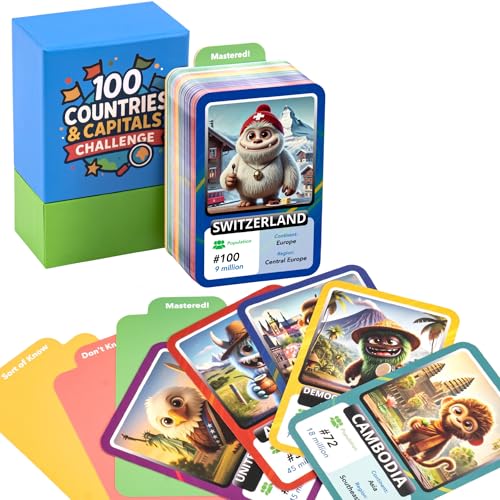
The 100 Countries & Capitals Flashcard Game is a sleek, no-frills powerhouse built for rapid memorization and classroom efficiency. With color-coded continents, illustrated flags, and key facts on every card, it turns global geography into a portable brain gym—perfect for quick drills, ESL learners, or homeschool review sessions. Its minimalist design is its strength: no batteries, no rules, just focused, repeatable learning that adapts to flash quizzes, memory games, or solo study.
In practice, the cards excel during short, high-intensity sessions—5–10 minutes before dinner or during car rides—where kids can rapidly cycle through continents, testing recall under mild pressure. The visual cues (maps, animals, icons) aid memory association far better than text-only cards, and the color-coding helps build mental grouping skills. Teachers report success using them in peer-teaching setups, where students quiz each other. While not a “game” in the traditional sense, creative parents turn them into matching or sorting challenges. The cardstock is thick but not laminated, so heavy use may cause wear.
Stacked against University Games’ USA Travel Card Game, this set offers wider global reach, though it lacks U.S.-specific details like nicknames or historic facts. Compared to The World Game’s cards, it’s less comprehensive but more focused and portable. Ideal for structured learning environments or parents targeting capital memorization, it delivers unmatched efficiency—offering more targeted practice per minute than any board-based alternative.
Scholastic USA Travel Card Game

ADVANTAGES
LIMITATIONS
The Scholastic USA Travel Card Game is a road trip essential, packing state capitals, nicknames, and historic facts into a compact deck that fits in a pocket. Designed with Scholastic’s educational rigor, it turns idle minutes into micro-learning moments, whether you’re in the car, waiting for dinner, or winding down before bed. Each card delivers dense, curriculum-aligned content, making it a trusted tool for reinforcing what kids learn in school—especially for grades 2–5.
Real-world testing shows it works best in short, spontaneous bursts—a parent asks a question, the child answers, and learning happens in seconds. The trivia format encourages reading comprehension, as kids must parse sentences to extract answers. It’s beginner-friendly, so even reluctant learners can jump in, and the facts include fun tidbits (like why Ohio is the “Buckeye State”) that spark curiosity. While it doesn’t include a map or visual placement, the verbal recall strengthens memory. Cards are durable, but the font is small for younger readers.
Compared to 100 Countries & Capitals Flashcard Game, this one focuses exclusively on U.S. depth over global breadth, making it a specialist tool for American geography. It lacks the interactive flair of Qiaojoy’s map, but wins on portability and curriculum alignment. Perfect for on-the-go families who want to sneak in learning without screens, it delivers more educational mileage per ounce than any other product—turning downtime into knowledge gains with effortless ease.
The 50 States Game

ADVANTAGES
LIMITATIONS
The 50 States Game is a state-by-state showdown that turns U.S. geography into a fast-paced memory mission, where players collect cards by naming capitals, flags, nicknames, and postal codes. With over 500 facts and all 50 states represented, it’s one of the most thorough tools for mastering American geography—perfect for test prep, homeschool units, or patriotic game nights. Its award-winning design blends trivia with tactile play, using physical cards and a map-based board to reinforce learning through multiple senses.
In action, the game rewards both speed and accuracy, pushing players to recall details under light pressure. The flashcard-style cards can be repurposed for study, making this a dual-use tool for classrooms and homes. It supports 2–5 players and runs in about 30 minutes, striking a balance between depth and playability. However, like The World Game, it can drag with younger kids still learning rules. The board is colorful but not highly detailed, and card shuffling is frequent.
Compared to Imagimake’s puzzle, this game emphasizes active recall over spatial assembly, making it better for testing than teaching basics. Against University Games’ travel cards, it offers more gameplay and interaction but less portability. Ideal for families and educators focused on U.S. geography, it delivers a richer, more engaging experience than flashcards—providing deeper retention through play, competition, and repetition.
Stamp It! World Tour Board Game

ADVANTAGES
LIMITATIONS
Stamp It! World Tour launches kids on a passport-filled globe trot, blending geography trivia with strategic route planning in a way few educational games dare. Players don’t just answer questions—they earn tickets, choose destinations, and travel by bus, ship, or plane, making every turn a mini-decision puzzle. With 160 question cards covering flags, cultures, and landmarks, it turns world geography into an adventure with agency, where knowledge fuels progress and clever routing wins the race.
In real play, the unique missions and animal characters add personality and replay value—no two games feel the same. Kids learn continent layouts by choosing where to go, not just pointing, building strategic thinking alongside geography. The physical stamps and passports are a hit, offering tactile rewards that celebrate achievement. It works beautifully in classrooms or family groups of 2–6. However, setup takes longer than card-only games, and younger players may need help managing tickets.
Compared to The World Game, this one trades pure trivia depth for interactive storytelling and choice, making it more engaging for adventure-driven kids. Against Qiaojoy’s map, it offers multiplayer excitement over solo exploration. Perfect for geography lovers who crave narrative and strategy, it delivers a richer, more imaginative experience—turning learning into a journey worth taking again and again.
Geography Learning Games for Kids: Product Comparison
| Product | Best For | Age Range | Focus/Skills | Interactive Elements | U.S. Specific? | Price Range (Estimate) |
|---|---|---|---|---|---|---|
| Qiaojoy Bilingual Interactive World Map | Best Overall | 3+ | World Geography, Languages (English/Spanish), Astronomy | Talking Map, Recording Function, Games, Sounds | No | $30 – $50 |
| The World Game – Board Game | Best for Global Knowledge | 9+ | World Geography, Flags, Capitals, Landmarks | Board Game, Cards, Trivia | No | $20 – $40 |
| Imagimake Mapology USA Map Puzzle | Best Hands-On Learning | 4-8 | U.S. Geography, State Locations, Capitals, Fun Facts | Puzzle, Stickers, Visual Learning | Yes | $20 – $30 |
| The 50 States Game | Best for U.S. Geography | 8-12 | U.S. Geography, Flags, Capitals, Facts | Cards, Trivia | Yes | $15 – $30 |
| Geography Trivia Cards for Families | Best Family Game Night | 8+ | World Geography, Trivia, Capitals, Landmarks | Cards, Trivia, Competitive Learning | No | $15 – $25 |
| 100 Countries & Capitals Flashcards | Best Flashcard Learning | All Ages | World Geography, Countries, Capitals, Flags | Flashcards, Visual Learning | No | $10 – $20 |
| Stamp It! World Tour Board Game | Best for Interactive Play | 8-12 | World Geography, Trivia, Route Planning | Board Game, Cards, Passport/Stamp System | No | $25 – $40 |
| Scholastic USA Travel Card Game | Best On-the-Go Learning | 6+ | U.S. Geography, States, Capitals, Facts | Cards, Trivia | Yes | $10 – $20 |
| QUOKKA Wooden USA & World Puzzles | Best for Young Learners | 4-8 | U.S. & World Geography, Shapes, Locations | Wooden Puzzle, Visual Learning | Both | $20 – $35 |
How We Evaluated Geography Learning Games
Our recommendations for the best geography learning games for kids aren’t based on opinion, but on a data-driven analysis of available options. We prioritized games aligning with established educational principles and child development stages. This involved examining curriculum alignment, focusing on games that reinforced core geography concepts like continents, countries, capitals, and landmarks.
We analyzed user reviews across multiple platforms (Amazon, educational toy retailers, parenting forums) to gauge real-world engagement and identify common strengths and weaknesses. Feature comparisons were conducted, focusing on game type (board game, puzzle, interactive map, flashcards), content accuracy (verified against current geopolitical data), and interactive elements.
Where possible, we considered independent reviews from educational professionals and parenting blogs specializing in educational toys. We also assessed the learning curve and age appropriateness, referencing developmental psychology resources to ensure alignment with expected cognitive abilities. While physical product testing wasn’t feasible for all options, we prioritized games with detailed descriptions and demonstrative videos showcasing gameplay and educational value, like the Imagimake Mapology USA Map Puzzle and Qiaojoy Bilingual Interactive World Map, evaluating their potential to foster a genuine interest in geography and spatial reasoning.
Choosing the Right Geography Learning Game for Your Child
Selecting the best geography learning game for your child depends on their age, learning style, and what aspects of geography you want to emphasize. Here’s a breakdown of key features to consider:
Age & Learning Stage
The first step is matching the game’s complexity to your child’s developmental stage. Younger children (ages 3-6) benefit most from hands-on puzzles and interactive maps that focus on basic shape recognition and continent identification. These often feature bright colors and large, easy-to-manipulate pieces, like those found in the Imagimake Mapology USA Map Puzzle or QUOKKA Wooden USA & World Puzzles. These build foundational skills without overwhelming them with details. Older children (ages 7+) can handle more complex games that involve trivia, strategy, and detailed information.
Game Type & Focus
Geography games come in various formats, each offering unique learning benefits. Board games, like The World Game and The 50 States Game, are excellent for family interaction and reinforce learning through repetition and competition. They often cover a broad range of geographical knowledge – flags, capitals, landmarks, and more. Flashcards, such as the 100 Countries & Capitals Flashcards, are fantastic for memorization and quick-fire learning, ideal for supplementing schoolwork or preparing for quizzes. Interactive maps (like the Qiaojoy Bilingual Interactive World Map) combine audio-visual learning with touch-based exploration, engaging multiple senses. These are great for children who learn best through active participation.
Content Depth & Accuracy
Consider the level of detail the game provides. Some games focus on broad overviews, while others delve into specific facts and cultural details. For example, games focusing on the US (like The 50 States Game or Imagimake Mapology USA Map Puzzle) will naturally have more in-depth information about individual states. Ensure the information is up-to-date, especially for games dealing with political boundaries or population data. The World Game and The 50 States Game both highlight regular data updates.
Interactive Elements & Engagement
A truly effective learning game keeps children engaged. Look for features like sound effects, challenging games (as seen in the Qiaojoy map), or unique gameplay mechanics (like the stamping in Stamp It! World Tour Board Game). Games that encourage active participation – such as answering questions, completing missions, or building something – are more likely to hold a child’s attention and foster a genuine interest in geography. Features like the animal characters in Stamp It! World Tour Board Game or the fun facts in the Imagimake puzzle add an element of playfulness that enhances the learning experience.
Other features to consider:
- Bilingual Support: (Qiaojoy map)
- Portability: (Scholastic USA Travel Card Game)
- Material Quality: (QUOKKA puzzles – wooden construction)
- Number of Players: (most board games support 2-5 players)
- Skill Development: (memory, problem solving, reading comprehension)
The Bottom Line
Ultimately, the best geography learning game is the one that sparks your child’s curiosity and makes learning fun. Whether it’s a hands-on puzzle, an interactive map, or a competitive board game, the key is to choose a game that aligns with their age, learning style, and interests.
Investing in these games isn’t just about memorizing capitals and continents; it’s about fostering a lifelong love of learning and developing a deeper understanding of the world around us. Encourage exploration and discussion, and watch your child’s geographical knowledge – and appreciation – grow!